Engaging Geometry Practice with the Types of Angles Game of Puzzle Worksheet
A Hands-On Tool for Angle Recognition and Degree Estimation
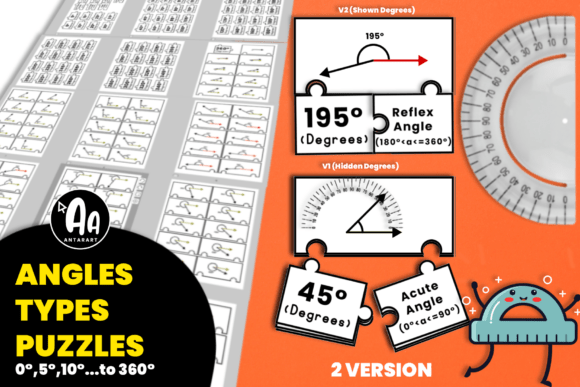
The Types of Angles Game of Puzzle Worksheet offers a tactile, visually clean approach to learning and reinforcing angle types and measurements. Designed for math educators, homeschoolers, and tutors, this resource supports geometry instruction across multiple grade levels. It includes two distinct puzzle styles: one that reveals exact degree values and another that conceals them, encouraging students to estimate and identify angles visually. With angles from 0° to 360° in 5° increments, this worksheet pack provides comprehensive coverage of acute, obtuse, right, straight, reflex, and full angles.
Key Features and Educational Value
This worksheet pack stands out for its structured yet flexible design. Each puzzle is built around precise angle representations, making it a reliable tool for reinforcing geometry standards. The inclusion of all 73 angles from 0° to 360° in 5° steps ensures students encounter a full range of angle types, not just the most commonly taught ones. The minimalist layout helps reduce visual clutter, allowing learners to focus on identifying and categorizing angles without distractions.
- Two puzzle formats support differentiated instruction: one with visible degrees for direct identification, another with hidden degrees for estimation and classification practice.
- Comprehensive angle coverage includes acute (less than 90°), right (exactly 90°), obtuse (between 90° and 180°), straight (180°), reflex (between 180° and 360°), and full rotation (360°).
- Print-ready design allows for easy integration into interactive notebooks, centers, warm-ups, or independent practice stations.
Practical Use in Classroom and Home Settings
Educators and parents will find the Types of Angles Game of Puzzle Worksheet adaptable to a variety of instructional settings. Whether used for whole-class review, small group reinforcement, or individual practice, the puzzles promote active engagement. The cut-and-paste format supports kinesthetic learning, while the matching game format encourages collaborative problem-solving. These activities are particularly effective for students who benefit from tactile learning experiences beyond traditional pencil-and-paper exercises.
In a 4th- or 5th-grade classroom, this resource can be used to introduce or reinforce angle classification before moving to protractor use. Middle school teachers may find it useful for review or intervention purposes. Homeschoolers can integrate it into structured geometry units or use it as a self-paced reinforcement tool. The worksheet’s clean design also makes it suitable for digital learning environments when paired with screen annotation tools.
Strengths in Presentation and Usability
One of the strongest aspects of the Types of Angles Game of Puzzle Worksheet is its visual clarity. The absence of decorative elements ensures that students aren’t distracted by unnecessary graphics, allowing them to focus entirely on the geometric content. The consistent formatting across puzzles builds familiarity quickly, reducing the learning curve and helping students concentrate on the math itself.
The worksheet’s layout also supports repeated use. Teachers can print and laminate sets for reuse in math centers or create individual copies for interactive notebooks. Because it’s not tied to a specific curriculum or textbook, this resource integrates smoothly into existing lesson plans, regardless of the core instructional materials in use.
Realistic Considerations and Limitations
While the Types of Angles Game of Puzzle Worksheet offers strong educational value, it’s important to consider its scope and format. As a printable resource, it requires access to a printer and basic supplies like scissors and glue for full hands-on engagement. It does not include digital versions or auto-graded components, which may limit its use in fully remote or tech-heavy environments unless adapted by the instructor.
Additionally, while the hidden-degree version encourages estimation, it assumes students already have some foundational knowledge of angle types. It may not be suitable as a first introduction to angles without prior instruction or visual examples. Educators should consider pairing it with direct instruction or anchor charts to ensure all learners can engage meaningfully.
Who Benefits Most from This Resource?
This resource is especially valuable for:
- Elementary math teachers introducing angle types in 4th and 5th grades.
- Middle school educators reviewing geometry concepts or supporting students who need reinforcement.
- Homeschooling parents seeking structured, tactile geometry practice.
- Special education teachers working with students who benefit from visual and kinesthetic learning tools.
- Tutors and intervention specialists looking for flexible materials to support individualized instruction.
It’s particularly effective in settings where hands-on, low-prep activities are needed—such as math centers, guided small-group instruction, or independent review stations. The worksheet also works well as a warm-up or exit ticket activity when used in part rather than in full.
Final Thoughts: A Practical Addition to Geometry Instruction
The Types of Angles Game of Puzzle Worksheet is a well-structured, focused resource that delivers on its promise of engaging, tactile geometry practice. Its clean design, comprehensive angle coverage, and dual-format approach make it a versatile tool for educators and parents alike. While it may not replace direct instruction or digital tools, it serves as an effective reinforcement activity that supports deeper understanding through active participation.
For those seeking a reliable, reusable, and adaptable geometry resource, this puzzle worksheet pack offers solid educational value. Whether used to introduce, practice, or review angle types and degrees, it helps students build confidence and accuracy in a format that’s both engaging and easy to implement.